
There’s a tension at the center of AI-generated content that doesn’t get resolved by either extreme of the debate. The “AI will replace writers” camp ignores that rankable, converting content still requires human expertise, perspective, and judgment. The “AI content is always low quality” camp ignores that generative tools, used thoughtfully, can produce genuinely valuable content at a speed and scale that changes what’s strategically possible.
The real conversation — the useful one — is about frameworks. How do you build a system that uses generative AI to produce content that both ranks and converts, without sacrificing the quality signals that Google increasingly uses to separate genuine expertise from machine-generated filler?
The Problem With Naive AI Content Generation
Most organizations that have experimented with generative AI for SEO content have run into the same wall. You prompt a model, it produces something that looks like an article, you publish it, and either nothing happens or — worse — it ranks briefly and then gets filtered as thin content. The content was technically accurate but semantically thin, topically generic, and conspicuously free of any real expertise or original perspective.
This isn’t a flaw in generative AI per se. It’s a flaw in how it’s being directed. A generative model trained on the internet will produce internet-average content when given internet-average prompts. If you want content that outperforms the average, you need to be much more deliberate about what you’re asking the model to produce — and more importantly, what role human expertise plays in the process.
A Framework That Works
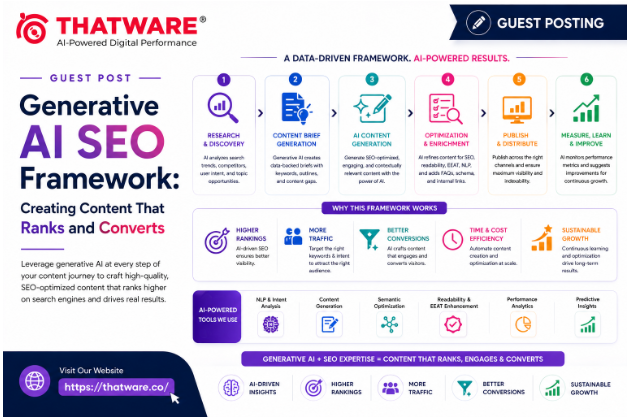
A well-designed generative AI SEO framework doesn’t use AI to replace the entire content production process. It uses AI strategically at specific stages where its strengths are most valuable, and keeps humans involved at the stages where judgment, expertise, and original insight matter most.
At the research stage: AI is genuinely excellent at processing large amounts of information, identifying patterns, and producing structured summaries of what a topic requires. Semantic analysis, competitive gap mapping, and intent modeling are all better done with AI assistance than without.
At the brief stage: the brief that comes out of that research should be highly specific — not just “write about X keyword” but “address these entities, answer these intent variants, establish these relationships, at this depth level, for this reader sophistication.” The AI did the analysis; a human strategist translates it into a production spec.
At the drafting stage: this is where the framework needs the most nuance. For certain content types — technical documentation, structured how-to content, FAQ pages — AI drafting with human review and editing can produce excellent results. For content where genuine expertise, original perspective, or unique experience is an EEAT signal — thought leadership, opinion, case studies, analysis — human authorship isn’t optional. It’s the competitive advantage.
EEAT and Generative Content: The Hard Truth
Google’s EEAT guidelines — Experience, Expertise, Authoritativeness, Trustworthiness — have become more central to ranking in any sensitive or competitive vertical. And EEAT, honestly, is hard to fake with AI.
Experience signals come from first-hand accounts, specific details that only someone who’s actually done something would include, and the kind of nuanced judgment that comes from working in a field for years. AI can simulate these, but Google (and more importantly, readers) are getting better at detecting simulation. The content that ranks strongest for EEAT signals tends to have a real human perspective behind it, even if AI tools assisted in research and structure.
This is the honest case for an AI content optimization framework that keeps humans central rather than marginal. The AI handles the volume and the structural intelligence. The human provides the perspective and expertise that make the content genuinely trustworthy.
Conversion: The Piece Most SEO Content Gets Wrong
Ranking and converting are different goals that don’t always align. Content that ranks well for informational queries isn’t always structured to move readers toward a commercial action. Content that converts well from direct traffic often performs poorly in organic search because it’s too promotional.
An effective generative framework addresses conversion architecture separately from ranking architecture. Ranking requires depth, breadth, and genuine information value. Converting requires clarity, trust signals, and clear next steps that flow naturally from the content rather than feeling bolted on.
The generative component can help structure calls-to-action appropriately for different stages of the reader’s journey — informational, consideration, decision — ensuring that the content earns trust before asking for anything. This is more sophisticated than dropping a form at the bottom of every article, and it produces compounding results because content that both ranks and converts is genuinely rare.
Building the System, Not Just the Content
The most important shift generative AI enables for SEO content isn’t producing individual pieces faster — it’s enabling a content system that would be impractical to build with purely human resources. Topic cluster coverage at the depth that establishes genuine topical authority. FAQ and supporting content that addresses the full range of search intent around a primary topic. Content refresh cycles that keep high-potential pages updated without requiring full rewrites.
None of this replaces strategic human judgment. But it enables strategic intent to be executed at a scale that changes what organic growth looks like.